
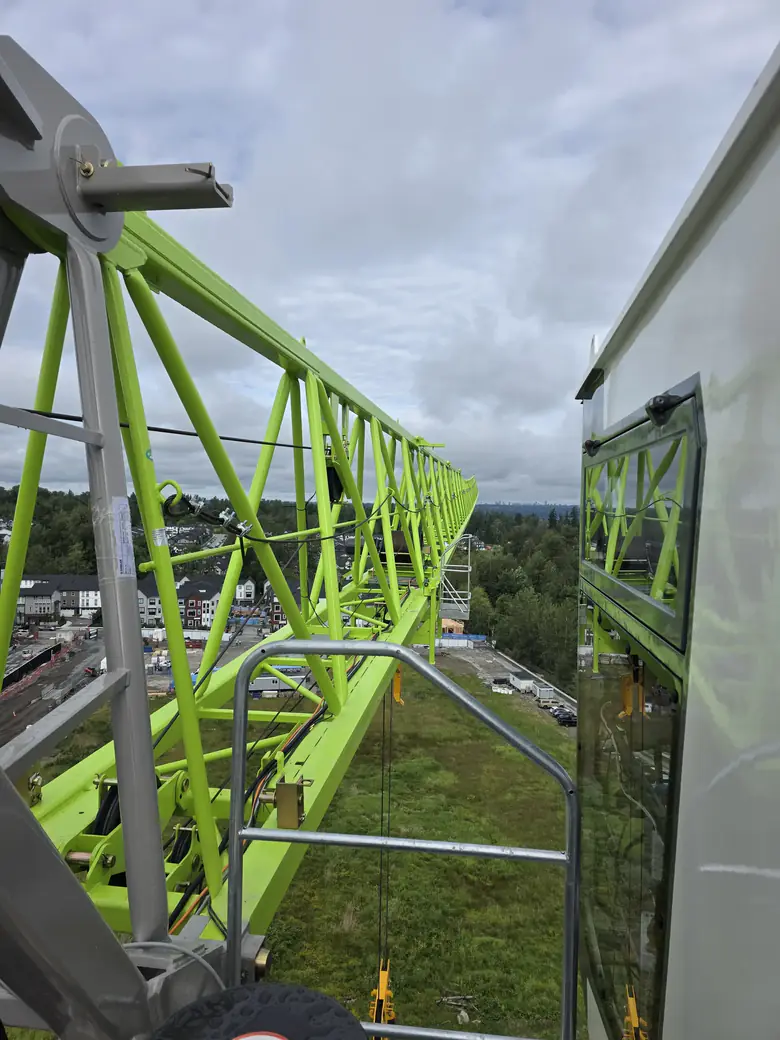
Tower crane rentals
Rent the Crane. Keep the Support.
QnQ provides tower-crane rentals backed by equipment knowledge, technical support and ongoing service. We help with the equipment selection, delivery, erection, climbing, maintenance, documentation and eventual dismantling.
What a rental covers
The Machine Is the Easy Part.
A rental covers the whole life of the machine on site, not its delivery. Crane problems are measured in days, and days are measured in budget. 6 steps, from the first conversation to the last load out.
- First conversation
Project Review
You tell us the site, the building, the schedule and what has to be lifted. We work out what the job actually needs before anything is quoted.
- Before you order
Equipment Selection
The crane is matched to the pour schedule, the site footprint and the budget — jib length, capacity and hook height against the real building, not the catalogue.
- Before it arrives
Delivery and Erection
The lift is planned, and the crane is delivered, erected and handed over commissioned with the sign-offs done.
- As you build
Climbing and Configuration
The crane rises with the structure, scheduled around the pour programme rather than ours.
- While it is on site
Service and Documentation
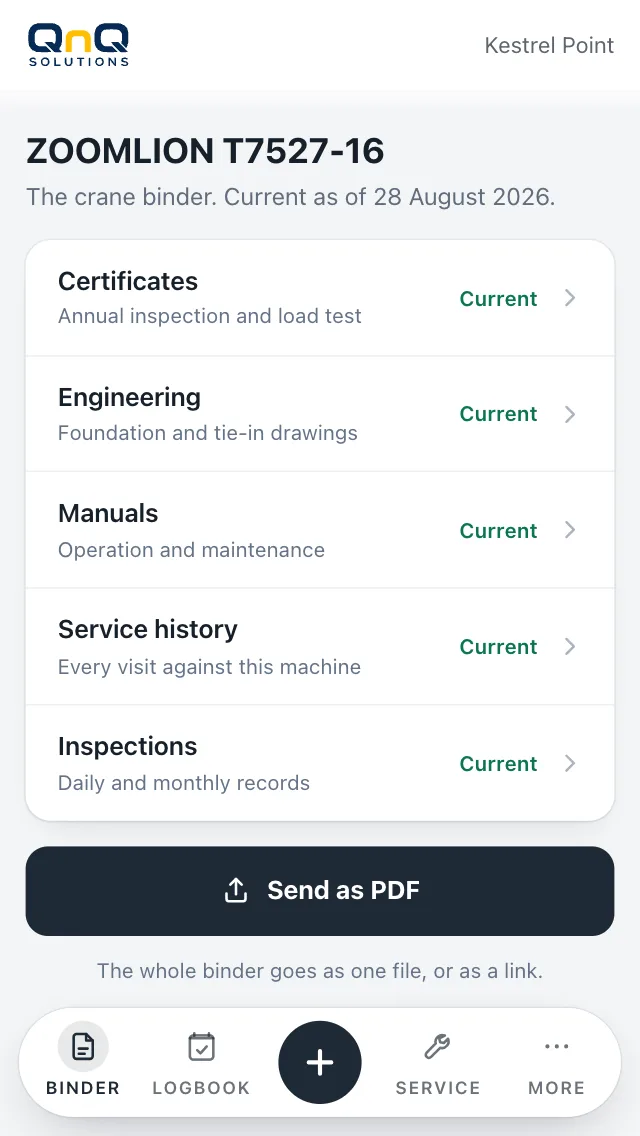
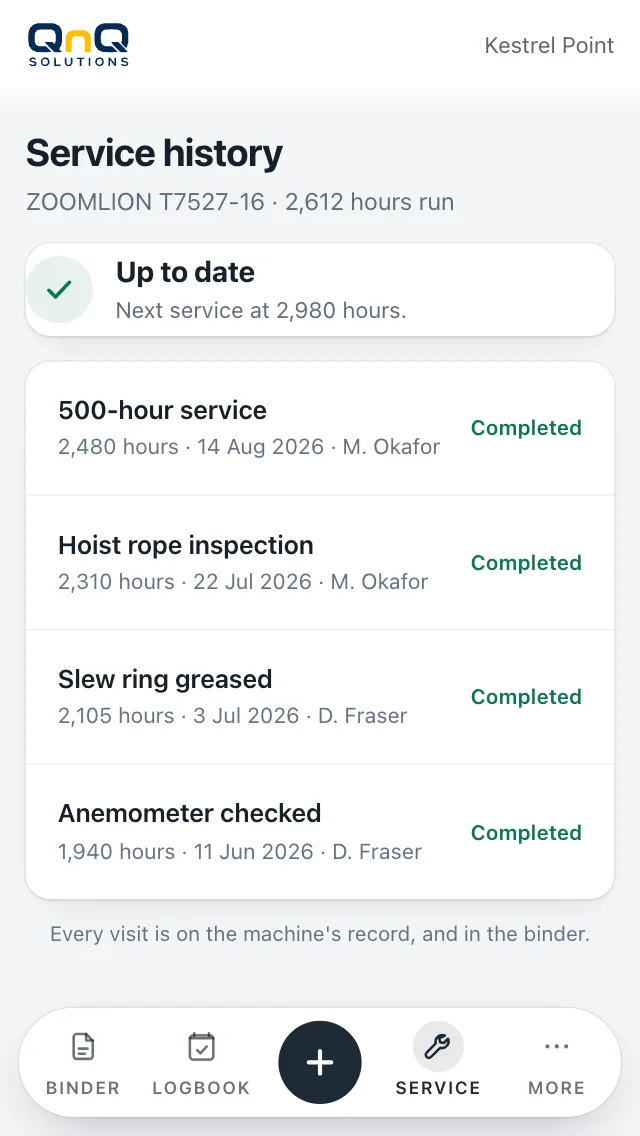
Servicing runs against the crane's real hours, certification is held current, and the records stay with the machine and open from a phone.
- When you're done
Dismantling
Removed on schedule, planned to the same standard as the erection.
- Throughout
Scheduled Servicing
Serviced by our own crew against the crane's real running hours. Nobody on your side is chasing a mechanic or tracking an interval.
- Throughout
Certification Kept Current
Annual inspection, load test and anti-collision commissioning, held current and flagged before anything lapses.
- Throughout
Orientation on the Machine
Operators are oriented on the exact model supplied, at no charge, with the means for supervisors to assess and record it.
20+ YearsIn cranes and construction
Up & DownErection, climbs and dismantle
347Sourced requirements kept on our own fleet
Included with every rental
The Paperwork Turns Up Already Done.
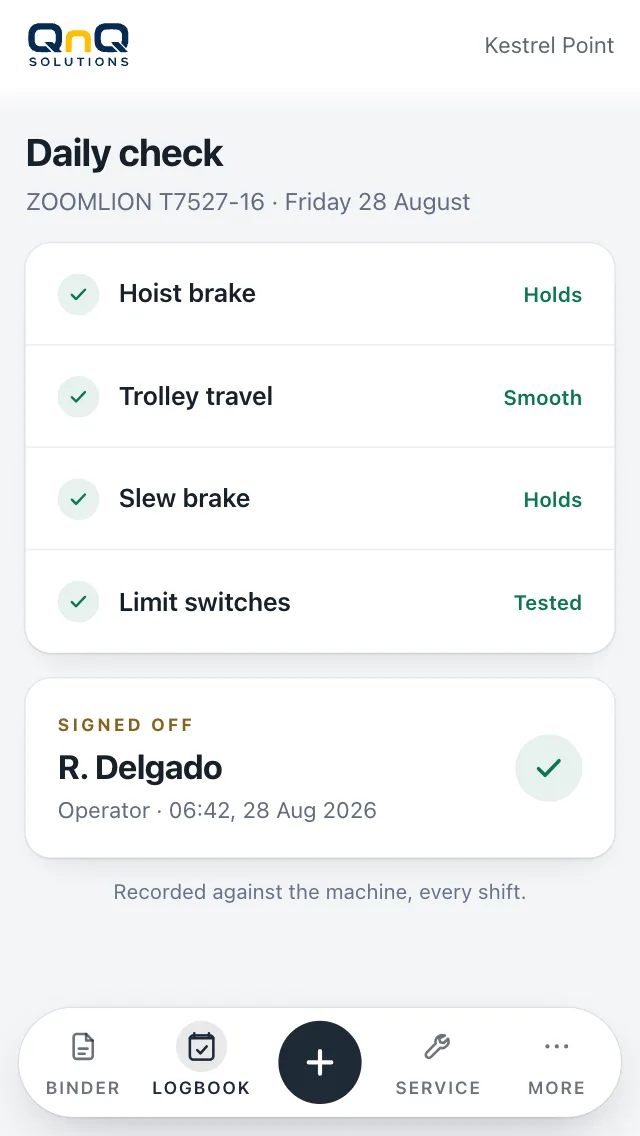
Every crane we rent out comes with Datum. The machine's binder, its service record and its certification live in one place, on the phone of everyone who needs them. Access is by phone number and PIN. No accounts and no installation.
Add-on service
We Can Take the Documentation On for You.
A tower crane brings a stack of obligations with it, and most of them land on the contractor rather than the company that delivered the machine. This work is carried out by a practising safety professional who deals with WorkSafeBC regularly.
Cranes sharing airspace, restricted visibility, or a load over an occupied structure. The OHS Regulation requires written procedures where crane operating zones overlap (s. 14.84.1), and treats a critical lift as needing its own plan (s. 14.42.1).
An inspector asks for the written procedure covering a task the crew carries out daily, and there is none.
It must stay with the crane and be completed each shift. Missing weeks are among the first things an inspector finds.
- Written for the site
Plans
An erection plan prepared for your site rather than a template, lift plans for the lifts that require one, and an anti-collision and zoning plan where cranes share airspace.
- Kept with the machine
Records
The daily inspection logbook that stays with the crane, ready for signature, and maintenance records showing what is due and when, each line referenced to the clause and page it comes from.
- For the crew
Procedures
Written safe work procedures for the tasks your crew actually carries out. Where there is an incident, we can take on the investigation and the reporting as well. Where the incident involves a crane we supplied, we will say so and help you appoint someone independent.
This is a separate service, quoted per job, and it is not included in the crane rental. Every piece of work is priced and set out in writing before it begins. It is carried out remotely, which is what keeps it quick and keeps the cost down.
Before you call
The Questions We Get Asked Most.
If yours is not here, call. You will speak to someone who knows the machines.
What does a crane rental from you actually include?
The machine, its erection, every climb as the building goes up, the dismantle at the end, scheduled servicing, and the certification kept current throughout. The crane's record — certificates, service history, inspections — is built in Datum and lives on the phone of anyone who needs it. You get a crane that works and paperwork that is already done.
Who is responsible for the inspections and certification?
We are. As the crane owner we carry that duty, and BC Crane Safety is explicit that on a rental the inspection findings and repairs must be filed at the crane's location for as long as it is there. That is exactly what the crane binder in Datum does — it stays with the machine, and it is there when an inspector asks.
Do you supply crane operators?
No — the operator is yours. What comes with the crane is everything needed to get them onto it safely: a model-specific orientation for the exact machine you have on rental, at no charge, and the system your supervisors use to assess that operator and record it against the crane. Making sure an operator is competent on the machine is the employer's duty, and in BC a tower crane may only be operated by someone holding a valid operator's certificate (OHS Regulation s. 14.34.1). This is how you discharge the competency side of it, and how you have the record when someone asks for it.
Do I need to know what crane I need before I call?
No. Tell us the building, the site footprint and the pour schedule and we will tell you the crane.
What is the difference between a flat-top, a luffing jib and a hydraulic luffer?
A flat-top is the most economical and the quickest to erect, and it lets 2 cranes work over one another. A luffing jib raises rather than reaching out, so the load stays inside your own airspace — the usual choice downtown or beside occupied buildings. A hydraulic luffer does both: it luffs where clearance is tight and works horizontally where it is not, so 1 machine covers a job whose requirements change part way through.
Can 2 cranes work over the same site?
Yes, and it is normal. Cranes are set at different heights so the jibs sweep past each other. The risk that has to be managed is the lower crane's jib meeting the taller crane's hoist rope and load. We supply ASCOREL anti-collision — we are the sole Canadian distributor — which slows the slew as cranes close and cuts it before contact, and fences the crane out of any airspace it must not cross.
Can you keep a crane away from a neighbouring building or a power line?
Yes. That is zoning. Prohibited areas are programmed in when the system is calibrated, and the crane simply cannot take a load into them. It can be a footprint on the ground or a corridor with a height limit, which is how overhead lines are usually handled.
What happens when the job runs longer than planned?
Tell us as early as you can and we will extend the rental. We track every machine's return date, so a crane coming back is not a surprise to us either.
Do you supply cameras and other equipment for the crane?
Yes — BCS crane cameras so the operator can see the hook on a blind lift, and Canadian-built accessories: self-dumping bins, trash hoppers, floodlights and below-hook rigging. Most contractors take them on the same order as the crane.
Before you sign with anybody
What the Rules Actually Require
We keep 347 sourced requirements across our own fleet, and we have written the plain-English version of what British Columbia asks for. Useful whether you rent from us or not.
Rental enquiries
Have a Project Coming Up?
Send us the location, the height, the schedule and the lifting requirements. We will return the crane, the price and how it gets up and down. For urgent requirements, call.